
In studies in the United States the CDC (Centers for Disease control) found that
many people do not know the symptoms of a heart attack and what to do. Only 5% of people knew all major symptoms.
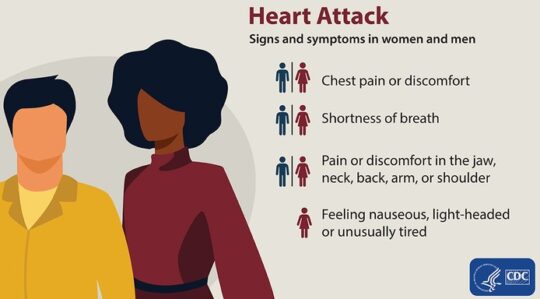
The CDC says:
“The major symptoms of a heart attack are
Chest pain or discomfort. Most heart attacks involve discomfort in the center or left side of the chest that lasts for more than a few minutes or that goes away and comes back. The discomfort can feel like uncomfortable pressure, squeezing, fullness, or pain.
Feeling weak, light-headed, or faint. You may also break out into a cold sweat.
Pain or discomfort in the jaw, neck, or back.
Pain or discomfort in one or both arms or shoulders.
Shortness of breath. This often comes along with chest discomfort, but shortness of breath also can happen before chest discomfort.
Other symptoms of a heart attack could include unusual or unexplained tiredness and nausea or vomiting. Women are more likely to have these other symptoms.”
The CDC notes:
“Call 9-1-1 if you notice symptoms of a heart attack.
If you notice the symptoms of a heart attack in yourself or someone else, call 9-1-1 immediately. The sooner you get to an emergency room, the sooner you can get treatment to reduce the amount of damage to the heart muscle. At the hospital, health care professionals can run tests to find out if a heart attack is happening and decide the best treatment.
In some cases, a heart attack requires cardiopulmonary resuscitation (CPR) or an electrical shock (defibrillation) to the heart to get the heart pumping again. Bystanders trained to use CPR or a defibrillator may be able to help until emergency medical personnel arrive.
Remember, the chances of surviving a heart attack are better the sooner emergency treatment begins.
Heart disease is the leading cause of death in the United States.
Heart attacks (also known as myocardial infarctions) occur when a portion of the heart muscle does not receive adequate blood flow, and they are major contributors to heart disease.
Early intervention is critical for preventing mortality in the event of a heart attack.
Identification of heart attack signs and symptoms by victims or bystanders,
and taking immediate action by calling emergency services (9-1-1),
are crucial to ensure timely receipt of emergency care and thereby improve the chance for survival.”
Remember that even though you need the consent of a sane, sober adult to give them care YOU DO NOT NEED consent to call 911,
and should call 911 if the person is experiencing signs and symptoms of a heart attack.
Do not drive the person yourself, or let them drive to the doctor/ emergency room.
The EMTs or Paramedics who arrive when you call 911 can start essential care before they get person to the emergency room,
sometimes saving their life on the drive there.

The CDC tells us:
“Cardiac arrest occurs when the heart suddenly and unexpectedly stops beating. Blood stops flowing to the rest of the body.
Cardiac arrest is not the same as a heart attack. ”
“ . . . More than 356,000 people have an out-of-hospital cardiac arrest in the United States every year, and about 60% to 80% of them die before reaching the hospital.
People at highest risk for cardiac arrest are older adults and men.
. . .Risk factors
In 2017-2020, 50.6% of men had high blood pressure, a major risk factor for heart disease and stroke.
High blood pressure is often underdiagnosed in women, and fewer than 1 in 4 women with high blood pressure (22.8%) have their condition under control.
Several other medical conditions and lifestyle choices can also put people at a higher risk for heart disease, including:
Diabetes
Overweight and obesity
Unhealthy diet High LDL (low-density lipoprotein) cholesterol
Physical inactivity
Excessive alcohol use.”
If you smoke or must breathe second-hand smoke.
One year after you quit smoking your risk of coronary heart disease is cut in half.
– – – – – – – – – – – – – – – – –
The CDC tells us:
Cardiac arrest has several causes, including:
Cardiomyopathy, which happens when the heart muscle becomes enlarged or stiff, leading to abnormal contractions,
Coronary artery disease, which restricts the flow of blood to the heart.
Heart valve disease occurs when a valve in the heart is damaged or diseased.
An arrhythmia, which is when the heart beats too slowly, too fast, or in an irregular way.
Although rare (fewer than 30 reported cases annually), a forceful blow to the chest, as from a hard ball or steering wheel, can also cause cardiac arrest. This condition is called commotio cordis (agitation of the heart).
. . . Lightning can cause cardiac arrest.”
From EMS World:
“Commotio cordis, also known as cardiac concussion, occurs when a person receives a blow to the chest during a vulnerable window during diastole of the heart. This concussive force, occurring during the upstroke of the T-wave, triggers ventricular fibrillation Sudden Cardiac Arrest. Commotio cordis can occur in both contact and noncontact sports and should be suspected anytime an athlete experiences blunt trauma to the chest followed by sudden collapse.”
Drug overdose. The American Heart Association (AHA) tells us: “The U.S. opioid epidemic and related opioid use disorder are significant causes of cardiac arrest and death among adults ages 25 to 64. . . In the case of opioid use disorder, they are frequently mixed with alcohol or other toxic substances, which increases the risk of overdose.”
The Substance Abuse and Mental Health Services Administration tells us:
“The majority of people with a substance use disorder started using substances during adolescence.
• Using alcohol or drugs during adolescence or young adulthood affects brain development which is not complete until about a person’s mid-twenties.
• About three quarters (74 percent) of 18- to 30-year-olds admitted to substance use disorder treatment programs began using substances at the age of 17 or younger.”
Breathing emergencies, such as drowning and choking can lead to cardiac arrest, if people do not get the correct first aid in time. The American Heart Association tells us: “With choking, if the obstruction – such as a grape or a small toy – is cleared, the person can start breathing normally. If not, the heart is eventually starved of oxygen and goes into arrest.”
– – – – – – – – – – – – – – – – – – – – – – – – – – – – – – – – – – –
Some reasons people might delay seeking medical attention (calling 911) when they are experiencing signs and symptoms of a heart attack include:
Lack of knowledge about, or failure to recognize, the signs and symptoms of a heart attack (symptoms can start slowly and persist for hours, days, or even weeks before a heart attack).
Denial or fear related to potentially having a life-threatening condition
Concerns about feeling foolish or embarrassed for seeking advanced medical care for a “false alarm”
Inadequate access to healthcare or a lack of healthcare insurance
– – – – – – – – – – – – – – – – – – – – – – – – – – – – – – – – – – –
The American Heart Assn (AHA) reports: “When CPR begins prior to the arrival of emergency medical services (EMS) personnel, the person in cardiac arrest has a two to three-fold higher likelihood of survival. An effective way to ensure that CPR is provided quickly is for the emergency telecommunicators”. . .(the person who answers the phone when you call 911) . . . “to provide instant instructions with telecommunicator CPR (T-CPR). T-CPR allows bystander CPR to begin – it works by keeping the brain and heart alive until EMS arrives to provide defibrillation and other vital interventions. T-CPR can assist the untrained caller as well as remind the CPR trained caller how to provide high-quality CPR.”
T-CPR (Telecommunicator CPR) is also known as
DA-CPR (Dispatcher-Assisted Cardiopulmonary Resuscitation)
– – – – – – – – – – – – – – – – – – – – – – – – – – – – – – – – – – –
– – – – – – – – – – – – – – – – – – – – – – – – – – – – – – – – – – –
(Note to on-line users not in my classes: this is a study sheet. It is not complete instruction in first aid or the topic named in the webpage title.)
The author of this webpage, (written as a homework reading assignment for my students), does not give any warranty, expressed or implied, nor assume any legal liability or responsibility for the accuracy, completeness, or usefulness of any information, product, or process included in this website or at websites linked to or from it. Users of information from this website assume all liability arising from such use.
– – – – – – – – – – – – – – – – – – – – – – – – – – – – – – – – – – –