If you do not have, and can not borrow a vehicle that can get to Yosemite National Park for the winter quarter weekend trip, we always suggest that you read everything about the trip and become an expert so you can convince another student who can drive to go on the trip.
As an alternative, there are various (fee charged) public transportation possibilities to the park
and free ones when you are in the park.
According to the park service “Amtrak provides a combination of train and bus service to Yosemite Valley.” “Greyhound provides bus service to Merced, where you can transfer to YARTS (Yosemite Area Rapid Transit) to continue to Yosemite Valley.” (This can be fun to do with other De Anza students on the trip and get to know each other on the way.)

Traveling on YARTS can also solve many other transportation issues.
If you have access to a vehicle and can drive but a parent does not want you driving in the snow.
OR you do not have experience driving in the snow and are not yet ready to try it
OR if your vehicle has tires too big to put snowchains on
OR you lowered your vehicle and there is not enough clearance under it to drive in even a little snow
OR you do not want to buy snow chains just for this adventure
Solution: you can drive yourself as far as Mariposa 75% of the way (Mariposa is 44 miles from Yosemite on Highway 140, the same route most people on this trip drive into Yosemite ).
and then take YARTS into the park and not have to deal with putting chains on.
Yosemite Park webpage about public transportation
YARTS has said: “Enjoy breathtaking views on your journey to Yosemite National Park without worrying about driving. YARTS over-the-road coaches offer a comfortable ride with plenty of storage space, onboard lavatories, ADA accessible seating, and large windows, perfect for enjoying the scenery.”
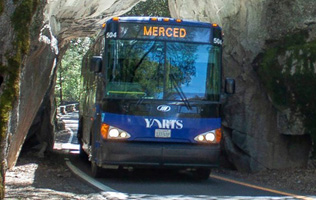
and yes, the YARTS bus fits in between the ginormous rocks at the Highway 140 (Arch Rock) entrance station:
– – – – – – – – – – – – – – – –
At this Google maps photo you can see the “YARTS Mariposa Park and Ride “ lot in Mariposa, with a roofed, partially enclosed bus stop: park and ride bus stop and parking lot in Mariposa California.
You would leave your vehicle there and ride into and back from Yosemite. Other passengers on the bus will include Yosemite employees and people staying in hotels in Mariposa who do not want to drive into the park.
– – – – – – – – – – – – – – – –
Once you are in the park, you do not need your own vehicle because you can use the
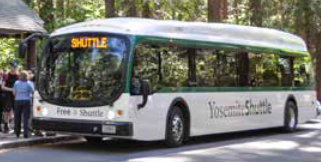
free year-round shuttle bus service,
(no ticket or reservation required)
with stops at most major sites of interest, visitor centers, museums, all overnight accommodations, stores, restaurants, ice rink and some trailheads.
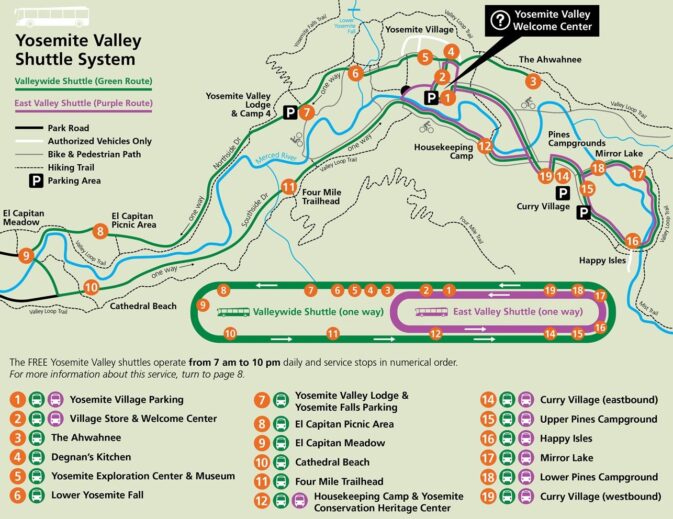
You can use the Yosemite valley free shuttle bus webpage with details about the free shuttle bus route to take a “tour” of Yosemite valley before you go to the park.
– – – – – – – – – – – – – –
And once you are in the park there is also a winter
Free bus to skiing, snowboarding, snowshoeing
Road and weather conditions permitting, the free bus to the ski resort for the snowshoeing, skiing and snowboarding leaves multiple locations in Yosemite valley
starting at Curry Village (two blocks walking, four blocks driving from the campground) at
(most years – note that some years, or parts of some winters, there is only one pickup time, not two) 8:05 a.m. and 10:35 a.m.
and makes stops at: Yosemite Village 8:10 and 10:40, (not every year – Ahwahnee 8:15 and 10:45),
Yosemite Lodge 8:30 and 11)
arrives at Badger Pass approx. 9:30 and 12:05 and returns from the ski resort at 2 and 4:30 p.m. arriving at Curry Village (again about two blocks walking, four blocks driving from the campground) approx. at 3 and 5:30 p.m. Confirm the return times when you get to the ski resort.
Allow at least one hour from the last pickup stop to get to Badger Pass; one hour for the return to Curry Village.
Look for the Shuttle link at Winter Badger Pass ski area
Please note that the schedule can change during the season (weekends only versus everyday / locations of stops / time of pickups),
and I might not know and be able to change this webpage, so you should verify when you get there.
In 2024 2025 2026 they added a note “Only one shuttle bus will be available each run with a maximum capacity for 45 people.”
Here, a line of (15!) people one morning in February 2023 wanting to get on the bus at the stop at Yosemite Lodge who were turned away because the bus was full. (The Outdoor Club people that year were early in line to get on the bus and none of us was left behind.) Notice, at the lower left, the doors open to the big storage section for your skis, snowboard and other bulky items.
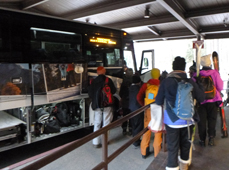
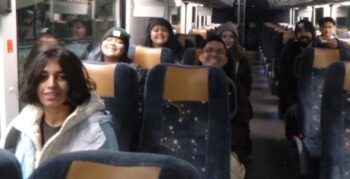
and here, in February 2026, a view of the bus interior, with people who were staying at Curry Village and got on at the first pickup at Curry Village, so they could be sure there was space for them:

If you rent a vehicle you should learn how to turn off car alarms/disable beeps at the rental business, BEFORE you leave for the trip and be sure the rental company will let you use chains. (A rental company explained chains policies this way “Most rental car companies discourage or forbid the use of snow chains on their vehicles. The reason is chains can cause damage to the vehicle’s wheel wells, tires, or to the road if not installed properly. Many rental contracts explicitly prohibit installing tire chains or cables. If you were to ignore that and damage the car, you’d likely be liable for the repairs, not to mention voiding insurance coverage.”)
Here a sign seen when exiting the park:
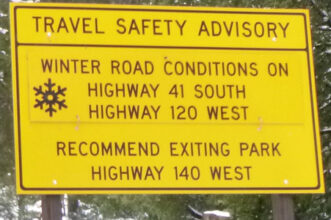
Most people on our trip take Highway 140 to the park, as you might not find any snow on that route and at least would not have to put chains on (but must have them with you).
You might want a copy of driving directions even if you use public transportation.
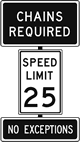
BUT do you reeeeealy need to have snow tire chains or cables for your vehicle?
The park service warns: “You will be subject to a citation (up to $5,000) if you fail to put on chains when required. Further, if you don’t have chains with you, you may have to call a tow truck to supply chains for you (this could cost up to a few hundred dollars and is not covered by AAA; the wait can be several hours).
Countless accidents are caused by motorists who lose control because they don’t have chains, and many of those drivers have winter driving experience. Don’t be responsible for injuring someone, damaging vehicles, or inconveniencing hundreds of other park visitors by causing an accident: use chains when required and drive with caution.”
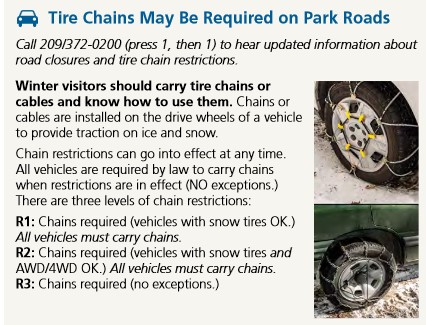
-ALWAYS CARRY TIRE CHAINS OR CABLES!
Make sure they are the proper size for your tires and are in working condition.
This is best done at home, on a dry day, in your driveway, before it snows.
It can be wise to practice putting chains or cables on before the trip if it has been awhile since you last used them, or if it was always some other person who uses the vehicle you will be driving who put the chains/cables on in the past. I suggest you practice while wearing the pair of warm gloves you will pack with the chains. Even a pair of first aid gloves could help keep your hands dry and a bit less cold. And packing a pad to kneel on when you are putting the chains on is also suggested (or do you already have individual knee pads for gardening / construction?). The kneeling pad could also be used as a mini seat cushion ( insulated from the cold a little) in your pop-up camping chair or on a picnic table bench.
Chains must be installed on the drive wheels (driving axle).
Make sure you know if your vehicle is front or rear wheel drive.
If you don’t know, ask your mechanic or check your vehicle owner’s manual.
If you have four-wheel-drive you owner’s manual will tell you which two wheels (rear?) to put the two sets of cables/chains on.
In the winter the Rangers often won’t let you drive with just four-wheel drive with snow tires
(or they won’t let you into the park),
even if the weather report is for sunny weather.
Some of the time you won’t have to put the chains on if you have snow tires (look for m+s or a similar designation for mud and snow on the side wall) but they must have tread at least 6/32 of an inch deep,
and you must always have chains with you.
Yup, even in the spring (April 5 message from Yosemite park after many inches of snow overnight: “Big Oak Flat Road remains closed from Big Oak Flat Entrance to Foresta junction. No estimate for reopening. Chains required on all other roads.”)
There are tow trucks from the Yosemite valley garage, but if it’s obvious that you slid off the road because you didn’t have chains during chains required conditions, CSAA or other auto club towing packages will not pay for the tow–you will.
Safe driving in Rain or Fog.
– pack a pair of safety googles with your jumper cables and take a look at Road trip vehicle prep and recommended service
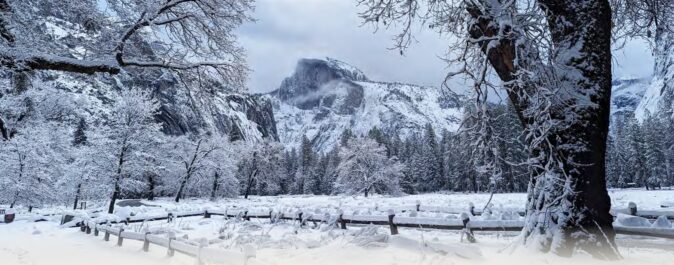
Will it actually snow during our trip? Maybe, maybe not. Snow camp weather, hike safety and first aid considerations
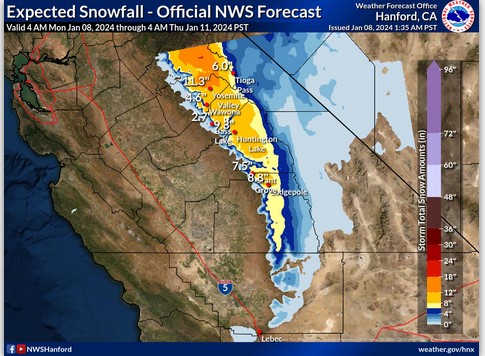
The National Weather Service has an expected snow fall map. The one below is not current, but is offered as an example:
Road trip advice and etiquette has ideas for limiting boredom and some packing and safety tips.

The author of this webpage, (written for my students), does not give any warranty, expressed or implied, nor assume any legal liability or responsibility for the accuracy, completeness, or usefulness of any information, product, or process included in this website or at websites linked to or from it. Users of information from this website assume all liability arising from such use.