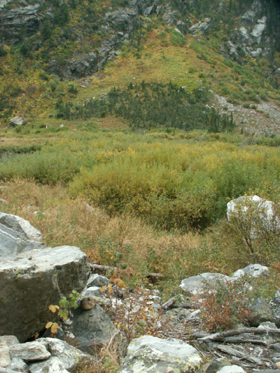
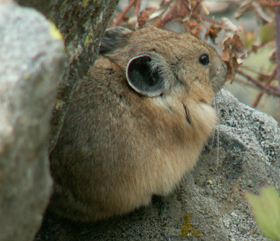
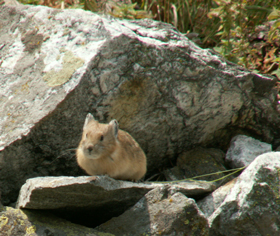
This pika’s home is right next to a trail through a talus field in Grand Teton National Park. By being quiet and sitting still, we were able to watch him for quite awhile.
Right across the trail, I just got this shot of a weasel:
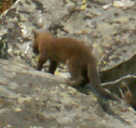
(The size of the animals in relation to each other in these photos is deceiving. The pika is about the size of a large potato and the weasel is the size of a large house cat.)
On another day we saw a Marmot and a Pika together along another section of trail:
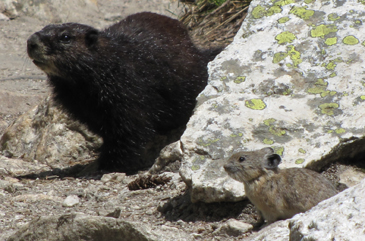
(The marmot in the photo above is a rare dark brown color, most have a yellow or tawny belly.)
and one year we watched a pika scampering with food to dry and store for eating during the winter.
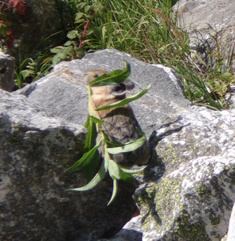
They store the food in “hay piles” between rocks:
“Haypiles vary greatly in size, from a few stems to several cubic feet of vegetation.”
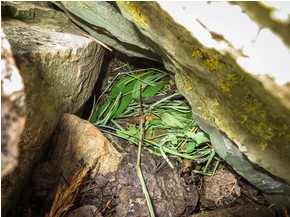
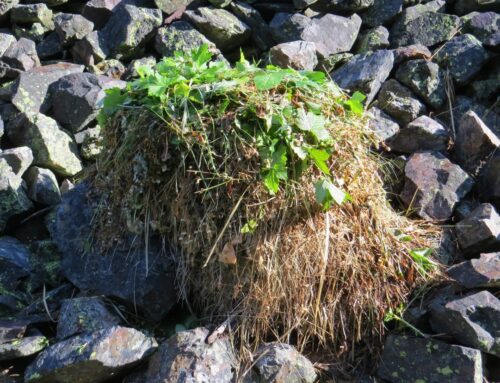
Below large haypile made mostly of ferns (in Mount Rainier National Park).
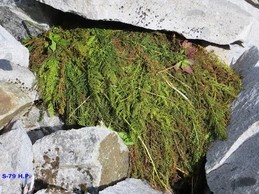
Most of the above photos were taken in Cascade Canyon, Grand Teton National Park Many others at this page are courtesy of Yellowstone National Park.
Most Americans pronounce Pika “pike-a”, Canadians pronounce it “peeek-a.”
Yellowstone National park offers these notes:
“Identification and Behavior
- 7–8.4 in. long, 5.3–6.2 ounces (about the size of a guinea pig).
- Active year-round; agilely darts around on rocks; travels through tunnels under snow.
- Breed in spring; two litters per year.
- Often heard but not seen; makes a distinct shrill whistle call or a short “mew.”
- Grey to brown with round ears, no tail. Blends in with rocks.
- Scent marks by frequently rubbing cheeks on rocks.
- In late summer it gathers mouthfuls of vegetation to build “haystacks” for winter food; defends haystacks vigorously.
- Haystacks often built in same place year after year; have been known to become three feet in diameter.
- Like rabbits and hares, pika eat their own feces, which allows additional digestion of food.
Habitat
- Found on talus slopes and rock falls at nearly all elevations in the park.
- Eat plant foods such as grasses, sedges, aspen, lichen, and conifer twigs.
- Predators include coyotes, martens, and hawks.
Management Concern
Pikas are vulnerable to loss of habitat related to climate change.
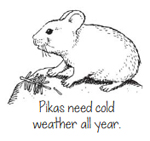
Behavior
Pikas are territorial. They inhabit rocky alpine and sub-alpine zones feeding on the vegetation that fringes their preferred talus slopes. Because pikas do not hibernate, this relative of the rabbit must gather enough plant materials during the short growing season to survive the winter. Piles of drying vegetation, called haystacks, and a distinctive high-pitched call are the most recognizable indicators of active pika habitat. Prolific breeders, pikas usually have two litters of young each summer. The mortality rate is high for the youngsters and the first litter has a greater rate of survival. These small mammals are sensitive to temperatures above 77.9°F (25.5°C); therefore, they are most active during cooler parts of the day.”
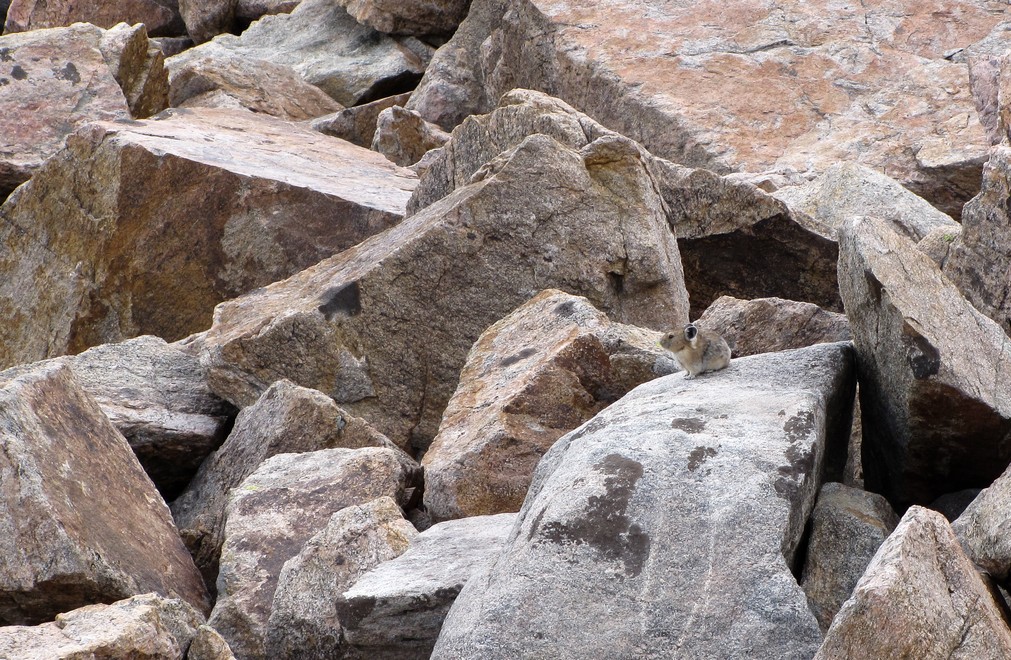
Because the small pika blends in with the talus slopes it lives on, it can be difficult to spot. Often you will note there is a pika in the vicinity because of it’s high-pitched bleat, “distinctive high pitched call”. Author /Ranger Beth Pratt notes: “Phonetic descriptions of their calls vary widely and include yink yink, chee-ick chee-ick, meep meep, eeep eeep, and eenk eenk.”
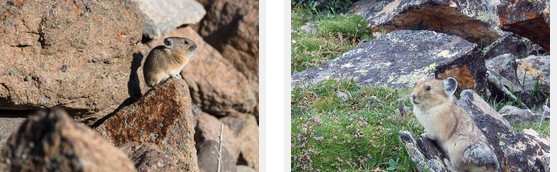
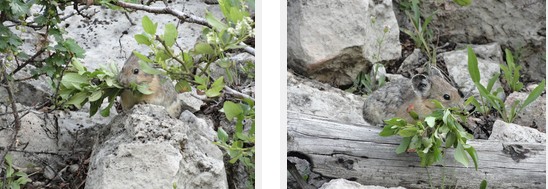
and more from NPS:
- Small mammals related to the rabbit family, even though they look more like a hamster or a guinea pig.
- Oval bodies that are only around 6 – 7 inches long and weigh just over six ounces.
- Short tail that is not externally visible on most individuals.
- Sharp curved claws and padded toes allow them to scamper around alpine rocks.
- Excellent hearing and vision to warn them of danger in their surroundings.
- Active year around–they do not hibernate.
- They dart through rocky areas and tunnels under snow.
- Vocal animals that use both calls and songs to communicate and protect their territories.
- A high-pitched “eek” warns other pikas of predators.
- Breeding season is in late May or early June while snow is still on the ground.
- Males sing to female mates.
- Gestation period is 30 days and litters of two to six hairless, blind infants are born.
- Females may have two litters a year and raise their young alone.
- After one month, the babies leave their mothers to establish their own dens, even though they don’t fully mature for another few months.
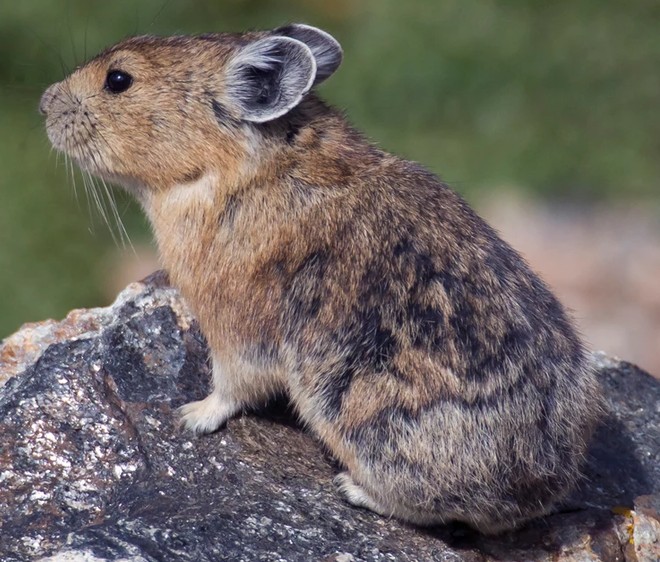
Rocky Mountain Mammal Size Comparisons
The author of this webpage, (written for my students), does not give any warranty, expressed or implied, nor assume any legal liability or responsibility for the accuracy, completeness, or usefulness of any information, product, or process included in this website or at websites linked to or from it. Users of information from this website assume all liability arising from such use.