Some people like the safety of a cell phone, others think it wrecks the ‘wilderness experience’.
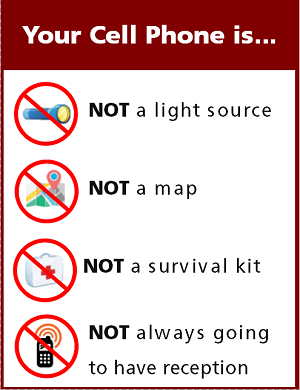
Turn off cell phones unless you must use them,
if you do use a cell phone, use it out of sight and sound of other people.
The biggest problem is people who bring a cell phone
instead of the essential gear/knowledge/and good judgement and expect to be bailed out,
or who take risks they wouldn’t without the backup of a phone.
Cell phone coverage in the wilderness (and in may non-wilderness areas in National Parks / National Forests) is at best variable and intermittent. Satellite phones do have better coverage, but even they are not 100% reliable as they can occasionally drop signals or otherwise malfunction.

Denali National Park warns:
“A note on technology in remote environments: Technology has a tendency to fail us just when we need it most. This trend is even more common in cold, wet, harsh environments which can wreak havoc on fragile equipment. Batteries die, the cold kills circuit boards, plastic housings break, etc. Your best contingency plan will always be self-sufficiency. Even when communication devices do work, rescue help cannot always reach you in a timely manner.”
From Risk Management for Outdoor Leaders, by the National Outdoor Leadership School:
“Never forget that a peril of portable phones is a loss of self-reliance. With the spread of cell towers and satellites, our society now has unrealistic expectations for rescues in the wilderness. Search and rescue personnel tell tales of adventurers who expect quick responses in the middle of nowhere while they sit passively and do little to help themselves. . .
Before you place the call be sure of how desperate your situation is and be certain you can’t handle it yourselves. Stop and think rather than allowing your emotions to take control. Perform a complete, careful assessment following all the steps in that first aid class you took. Listen for the whistle your supposedly lost friend would be blowing (you all carry one, don’t you?)”
__________________________________
“Cell phones can be helpful, but they are not 100% reliable. Dead zones exist even in Yosemite Valley, and phones are worthless without a charge. While it’s important not to rely on cell phones, they can nevertheless be lifesavers, so consider one for each person in case members of the party become separated” is a quote from A Winter Trail Run to Half Dome Nearly Ends in Disaster
__________________________________
Teton County Search and Rescue offers this:
“WHAT SHOULD YOU SAY WHEN YOU CALL 911?
1. Provide your location first in case the call gets dropped.
2. Include the nature of the accident and condition of the person in need.
3. Try not to move around when speaking so that the call does not drop.
4. Unless you are in immediate danger, stay in your same location until Search & Rescue arrives”

The National Association for Search and Rescue had this advice:
“Be SMART about using a Personal Locator Beacon (PLB) or other Satellite Emergency
Notification Device (SEND, e.g. Spot) or cell phone during backcountry or wilderness travel.
1. If you answer ‘No!’ to ‘Would I go there without my PLB, SEND or cell phone?’ then don’t go there with it!
2. Would you normally do something that might fracture your pelvis, freeze your hands or feet, kill you by heat stroke, suffocate you under snow, drown you or get you lost for days? If you answer ‘NO’ – then don’t do it relying on a signaling device!
3. Don’t think “It won’t happen to me – that happens to someone else.” Backcountry and wilderness travelers must know how to:
Prepare for,
Recognize and
Prevent an emergency
4. Always use these devices for the unforeseen – not as a last resort tool to handle what should be foreseen. It is dangerous and irresponsible to think they “allow” going somewhere or doing something you are not prepared or experienced to do.
5. Carrying an electronic signaling device does not make you safe. No distress beacon or cell phone offers warmth, shelter or first aid. They only make it easier to summon emergency help – after you are injured, lost – or worse. And once rescuers have been notified, weather and terrain conditions may prevent or delay them from reaching or even finding you.
6. When you activate any emergency signaling device, a full-scale emergency response will begin using local, state and / or national emergency agencies. It is only appropriate when a true emergency exists.
7. PLBs and SENDs are useful devices that save lives. You should think ahead about when to use one responsibly.
(‘SEND’ – A distress signal transmitter that uses satellites for communication, other than a PLB (Personal Locator Beacon, for individuals), ELT (Emergency Locator Transmitter, for aircraft) or EPIRB (Emergency Position Indicating Radio Beacon, for boats.)”
Consider how much effort will be put into a rescue, here quotes from various National Park Service reports:
“The rescue team consisted of 16 park employees.”
“The litter team ran two miles, fully loaded with gear, in order to expedite a wheeled litter carryout to a waiting ambulance.”
“More than 30 NPS employees and a contract helicopter were utilized to search the major drainages and canyons within the highest probability search area.”
“A full-scale search involving three helicopters, dog teams, hikers, horses, and swift-water trained personnel is ongoing.”
“After Teton Interagency Dispatch Center received notice of the accident, two rangers immediately began hiking and running to the location. They covered approximately four miles with an elevation gain of 2,700 feet in 90 degree heat, reaching Bell in less than two hours.”
“Joining the search were the park’s aircraft, Metro PD SAR teams, a Metro PD helicopter, and an interagency fire crew and helicopter.”
Grand Teton park spokesperson Jackie Skaggs said because of having an electronic device,
“people have an expectation that they can do something stupid and be rescued.
Every once in awhile we get a call from someone who has gone to the top of a peak, the weather has turned and they are confused about how to get down and they want someone to personally escort them. The answer is that you are up there for the night.”
If you call, be ready to give specific details of the problem and your plans and alternate plans. Realize that you need to be concise in the first sentence you speak over a cell phone of your problem, location and needs, as the cell phone could stop working before you can finish what you need to say.
From Yosemite SAR: “Keep in mind that cell phones that work fine at home, may not work in the park. If yours works and you need emergency help, it is imperative that you call 911 instead of texting” (a relative/friend to get help) because text messages can be lined up in a queue and sent out belatedly.
Until they get a better system in place, when you call 911 from a cell phone you can get dispatch for the Highway Patrol in a far-off city instead of the park rangers or forest service where you are traveling. The Highway Patrol dispatch may have no idea how to quickly contact the people you need. If you intend to use that cell phone, find out what the eight digit direct dial phone number is for the help you could need. It can often be found in the National Park newspaper you get when you enter the park (or the newspaper online).

Find a compass, altitude, latitude and longitude on your cell phone .
Knowing the elevation you attained on a hike and or climb can be fun for the been-there-and-done-that part of your adventure. Below, a photo taken of the compass app on a cell phone at Lake Solitude, Grand Teton National Park:
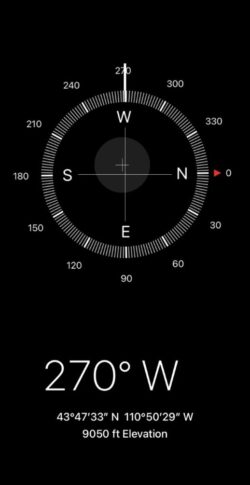
The 270 degrees W (west) shows the direction the cell phone was pointing, useful for orienting to a typographical map.
__________________________________
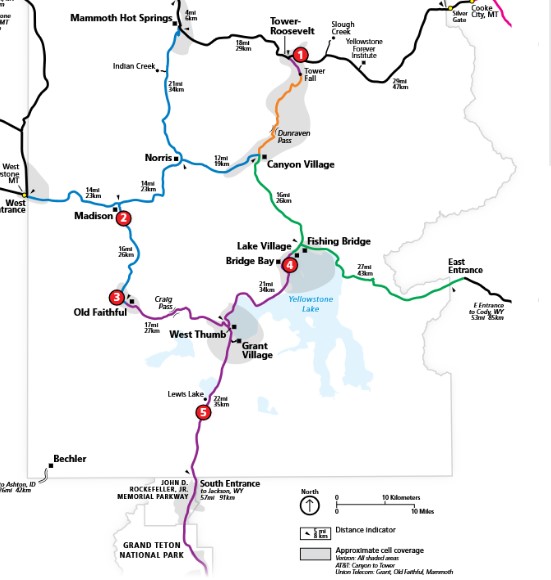
The Yellowstone Park newspaper, that you get a copy of when you enter the park, offered a map of cell phone coverage (summer 2025), that said “Approximate Cell Phone Coverage: Verizon all shaded areas, AT&T Canyon to Tower, Union Telecom Grant Old Faithful, Mammoth.” No cell phone coverage in most of Yellowstone Park.

Hiker Seriously Injured while Scrambling near Illilouette Fall
“July 12, 2012 Posted by: Yosemite Search and Rescue
Around noon last Thursday, June 28, a 65-year-old male set off from Lower Pines Campground in Yosemite Valley for an off-trail hike. The subject was a frequent visitor to Yosemite in excellent physical condition. Before leaving on his hike, the subject left a voicemail for his wife indicating his planned route. Fifteen minutes after his phone message, as a back-up plan, the subject decided to send a text to his wife: “I’m hiking up to Illilouette Fall again. Check in with you later…” Little did he know at the time, his wife, who was elsewhere in Yosemite Valley taking an art class, would never receive the text, and only hours later would discover that the voice mail message was waiting for her. The subject left the trail at the confluence of the Merced River and Illilouette Creek and headed up the Illilouette Creek drainage toward the base of Illilouette Fall, scrambling and climbing over boulders of every size, and not once encountering another person. Near the base of Illilouette Fall, the hiker left the creek bed and started scrambling up much steeper terrain (class 5) toward Glacier Point. The hiker suddenly lost traction, slipped, and took a tumbling 100-foot fall, coming to rest at the base of a granite apron not far from the base of Illilouette Fall. Describing the incident later to rangers, the subject explained that it “took a long time to assess what had happened.” The subject never lost consciousness, but collecting his thoughts was a protracted process. He realized his injuries were serious-in fact, incapacitating-and that he needed help.
The first contact the subject made with the outside world was via cell phone; he called his wife’s cell phone at 4:02 pm, 4:08 pm, and at 4:30 pm. His wife was still in her art class; later, when she turned on her phone, the missed calls did not show up on her cell phone. The subject also sent a text to 911 at 4:14 pm that simply read, “SOS,” and in reply, he received a standardized text message, time stamped at 4:15 pm, that read, “Please make a voice call to 911. There is no text service available to 911 at this time.” The subject doesn’t remember when he received or noticed the text; regardless, he never made a voice call to 911. At 4:52 pm, the subject sent a text to his wife, “Help. [Subject’s name].” which was again delayed. The subject’s wife received a voice call at 5:14 pm from the subject. She could see the call was from her husband, but when she answered her phone, there was no voice connection. Ten to fifteen minutes later, she received his 4:52 pm text. The subject’s wife also saw that a voicemail was waiting for her, but being out of her local calling area, she didn’t know how to access her messages. She called her son, who accessed her voicemail remotely and called his mom back, reporting that her husband was traveling to “Silhouette Falls.” Knowing that her husband was in some kind of trouble and with an idea that, like the last time they visited Yosemite, he had journeyed up the Illilouette Creek drainage, the subject’s wife sought help from the NPS volunteer at the Lower Pines campground, who then called rangers to the scene. The rangers were then able to communicate directly with the subject on his cell phone, and at sunset, a team of three rescuers headed up the drainage to find him.
When the rescuers found the subject, it was close to dark. The subject was lying on his back, not moving. To immobilize the subject’s spine, the rescuers packaged him in a vacuum body splint, covered him with a sleeping bag, and settled in for a long night. The next morning, the subject was extracted from the backcountry by helicopter via short-haul. At the Ahwahnee Meadow, the subject was transferred to an NPS ambulance and transported to the Yosemite Medical Clinic. The subject was later transferred to the trauma center at Community Regional Medical Center in Fresno. His notable injuries included: four full-thickness scalp lacerations, a cervical vertebra fractured in two places, a fractured thoracic vertebra, a fractured right pelvis, and an open fracture of the left ring finger. During the entire ordeal the visitor remained calm and had a positive attitude and is expected to fully recover from his injuries.This incident demonstrates the capacities, and shortcomings, of cell phone use in Yosemite. Although cell reception is common within park boundaries, reception still tends to be spotty and unreliable. Additionally, as this case highlights, there is the very real issue of time delays in receiving text messages and voicemail messages-according to the park’s director of telecommunications, often messages land in a queue and are sent out belatedly. Keep in mind that cell phones that work fine at home, may not work in the park. If yours works and you need emergency help, it is imperative that you call 911 instead of texting.
This incident also highlights how incredibly easy it is to get into treacherous terrain. In reflecting on his accident, the subject was clear that he “should have known better,” further explaining: “I know my limits. I can handle class 3, even class 4 if I had to, but I was not geared for technical climbing; I didn’t have protection. I have learned my lesson.”

advice from North Cascades National Park
In a discussion of 1998 search and rescue incidents, Rangers at North Cascades National Park warned that cell phone calls for help “influence search and rescue for better and or worse”…
“Carrying A Cell Phone?
Packing a telephone with the climbing gear is a fairly recent development, but now, not uncommon. Climbers carrying cell phones are finding that in many (mostly high elevation) areas of the North Cascades, reception can be quite good. However, others attempting to use a cell phone as an emergency communication tool have found reception to be fickle, at times with unexpected consequences.
Cell phone use also remains controversial amongst wilderness purists. While agencies generally have not taken a position, from a practical standpoint, rangers have observed that the technology is definitely influencing the search and rescue business for better or worse.
In several incidents, phones have successfully alerted rescuers to mountain accidents in North Cascades National Park, allowing rescue to begin hours before it would have without phone notification. But with equal frequency, the use of a phone in an initial distress call has resulted in what is referred to as a “bastard search” — a response by rescuers for a situation in which their assistance is unnecessary.
For those climbers packing a phone to potentially use in the event of an accident, the following information could prove useful:
If you are in North Cascades National Park the best number to call is Park Dispatch at (360) 873-4500, ext. 37. Dialing 911 or the appropriate County Sheriff’s office will work, but will take longer, as they then call the North Cascades dispatch when it is clear the caller’s location lies within the Park.
Always state your location and cell phone number early in the call in case connections fail and a callback is necessary.
Be aware that if you get through once, it does not mean a connection can be made a second time, even from the very same location. Consequently, it is important to communicate clearly the purpose of your call in your first connection, and if you are requesting assistance.
Depending on circumstances, a plan to ‘call back’ later without a clear first call might very well give you a rescue response you didn’t intend to initiate. Agencies with emergency response duties are required to investigate and resolve all reported incidents.
As phone technology advances, the unsuredness of dependable connections in remote areas may be eliminated. But for now, climbers are cautioned to not substitute the phone for preparedness. And if putting one to use in summoning help, be aware that a well-planned call can make a lot of difference.”

Advice for climbers from Grand Teton National Park: (please note that you should confirm the phone number below when you arrive in the park and go to a Ranger Station to talk about your climbing plans.)
“In the Event of a Life-Threatening Injury
Efforts should be made to obtain assistance as soon as possible. Cell phone notification is by far the most common method of notification. Calling Teton Interagency Dispatch (1 307-739-3301) directly will avoid potential confusion by eliminating the chance of your emergency call going to another county’s dispatch center. Program this number into your cell phone before your climb. If that number doesn’t work dial 911.
If cell phone service is not available, try sending a text to Teton Interagency Dispatch (1 307-690-3301). If that doesn’t work try a friend or family member and have them call for help. Text messages require less signal strength and often transmit when cell phone calls cannot connect.
Download the new BackcountrySOS App! BackcountrySOS is a simple-to-use smartphone app that allows you to quickly get your status and location information to emergency personnel.
If possible, send an extra member of your party or try to notify an adjacent party on the mountain, who can get to an area with cell phone reception or hike out to get word to the Jenny Lake Ranger Station (or any Visitor Center). Do not leave the injured climber alone unless absolutely necessary.
Information needed by the rescue team includes:
1) the exact location of the injured climber
2) the time of the accident
3) the nature and extent of injuries & medical care being provided
4) equipment at the scene (ropes, hardware, first-aid kit, etc.)
5) the number of people with the injured party
6) the plan of action (if any).”
From the National Park Service Morning Report,
Thursday, February 23, 2006
“Grand Teton National Park (WY)
Skier Rescued Near Taggart Lake
Rangers rescued an injured backcountry skier near the west shore of Taggart Lake on Saturday evening, February 18th. A 42-year-old woman from Jackson, Wyoming, fell and seriously injured her right leg while skiing in Avalanche Canyon and was unable to ski out to the Taggart Lake trailhead on the Teton Park Road. The woman’s companion employed a cell phone to make a 911 call. While rangers on snowmobiles headed toward her location, the woman and her companion fashioned a makeshift splint to stabilize her leg. They met up with three other skiers who were in the vicinity, and they helped her in her efforts to ski further. The group worked their way down Avalanche Canyon for about two miles before a change in terrain made it difficult for the woman to continue. Rangers reached her at 7:20 p.m. and placed her in a rescue sled towed behind a snowmobile. After they transported her to the trailhead, she was driven by private vehicle to St. John’s Medical Center in Jackson for treatment of her injuries. Rangers credited the woman, her companion, and the other backcountry skiers for their emergency self-rescue work. [Submitted by Jackie Skaggs, Public Affairs Specialist]”

Jeff and Kathy, the 08-09 + Tuolumne winter rangers, recommended esa avalanche (and click on advisory) for people considering the multi day ski trek to the Tuolumne Meadows ski hut. There they had a note about interference between cell phones, iPods and avalanche beacons:
“Another issue is radio frequency interference (“RFI”). With so many different electronic devices carried by backcountry recreationalists these days, complete testing of every possible device is infeasible so I’ll cover this briefly here. I have found that a *transmitting* cell phone (CDMA band) or FRS/GMRS radio can cause interference to varying degrees in some (but not all) beacons. But no beacons suffer RFI from an on-yet-not-transmitting phone or two-way radio. Far more importantly, playing an iPod will cause RFI to vary degrees in *all* avalanche beacons at close range. My general conclusions with RFI are: Be very careful if deciding to call for help while simultaneously searching with an avalanche beacon; and if you are touring with any brand of avalanche beacon, never listen to an iPod. (I am very serious about this: the potential for an iPod to be inadvertently left on and then cause interference in a beacon search is dangerous.)”
see also: GPS is not infallible
 You can’t always expect a helicopter rescue
Thunderstorm and lightning safety includes a warning about not using your cell phone or IPod during a storm.
The there is no guarantee of rescue webpage
includes accident prevention tips many people who are experienced hikers and backpackers do not know about.
The use of cell phones for photography (with or without a selfie stick) has made preventable injury or even death by selfie common They were just taking a selfie . . .
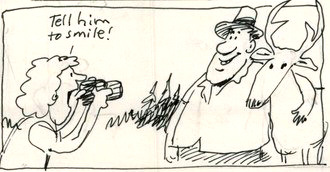
Safe distances from wildlife includes reasons to stay away from even friendly seeming animals in parks and charts and photos to better be able to determine and visualize how far away from wildlife you need to stay to be safe (and obey laws that do have penalties).
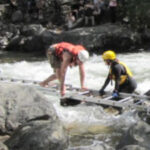
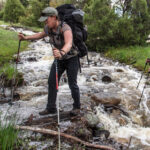
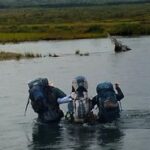
Crossing streams safely includes advice from Mount Rainier National Park, Yellowstone National Park, Great Smoky Mountains, and Yosemite National Park.
– – – – – – – – – – – – – – – – – – – – – – – – – – – – – – – – – – – – – – – – – –
The author of this webpage, (written for my students), does not give any warranty, expressed or implied, nor assume any legal liability or responsibility for the accuracy, completeness, or usefulness of any information, product, or process included in this website or at websites linked to or from it. Users of information from this website assume all liability arising from such use.